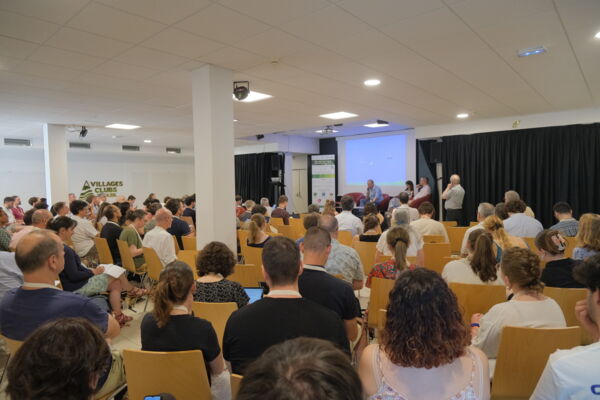
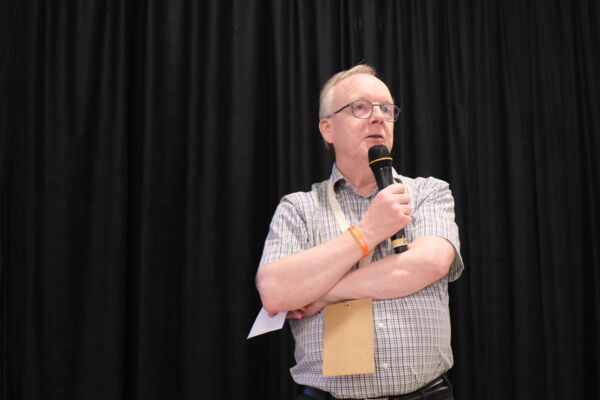
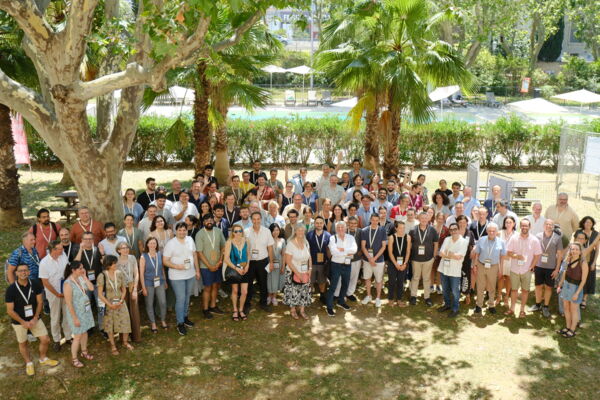
On the programme this year:
- An overview of developments and prospects in biotechnology with Claudia Vickers (Queensland University of Technology), Arnaud Legris (Arsenale Bioyards), Bastien Bissaro (INRAE, BBF laboratory) and Larissa Perotta (Axens).
- An inter-project workshop to discuss the aims of the bioeconomy, led by the PEPR’s humanities and social sciences research strand.
- Inspiring accounts of the transition from research to entrepreneurship with Julien Durand, Sophie Barbe and Philippe Gabant.
- Forward-looking workshops to envision the innovations of tomorrow: the competitiveness of bioprocesses, the role of living organisms in production systems, bioreactors of the future and the development of the bioeconomy.
- ‘My PhD in 180 seconds’ presentations showcasing the work of the programme’s PhD students.
- Discussions with the Bioeconomy For Change competitiveness cluster on synergies and opportunities for the community.
- A lecture on the impact of artificial intelligence on scientific research and publications, presented by Didier Torny (CSI Mines Paris).
- A session dedicated to the commercialisation of research results, in collaboration with BIOSCALE and innovation transfer stakeholders (INRAE Innovation, INRAE Transfert, Toulouse Tech Transfer).
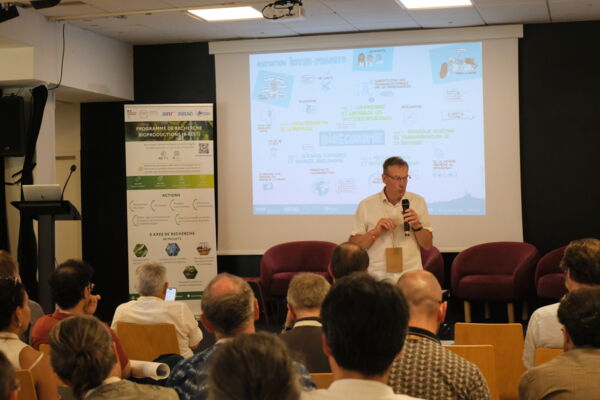
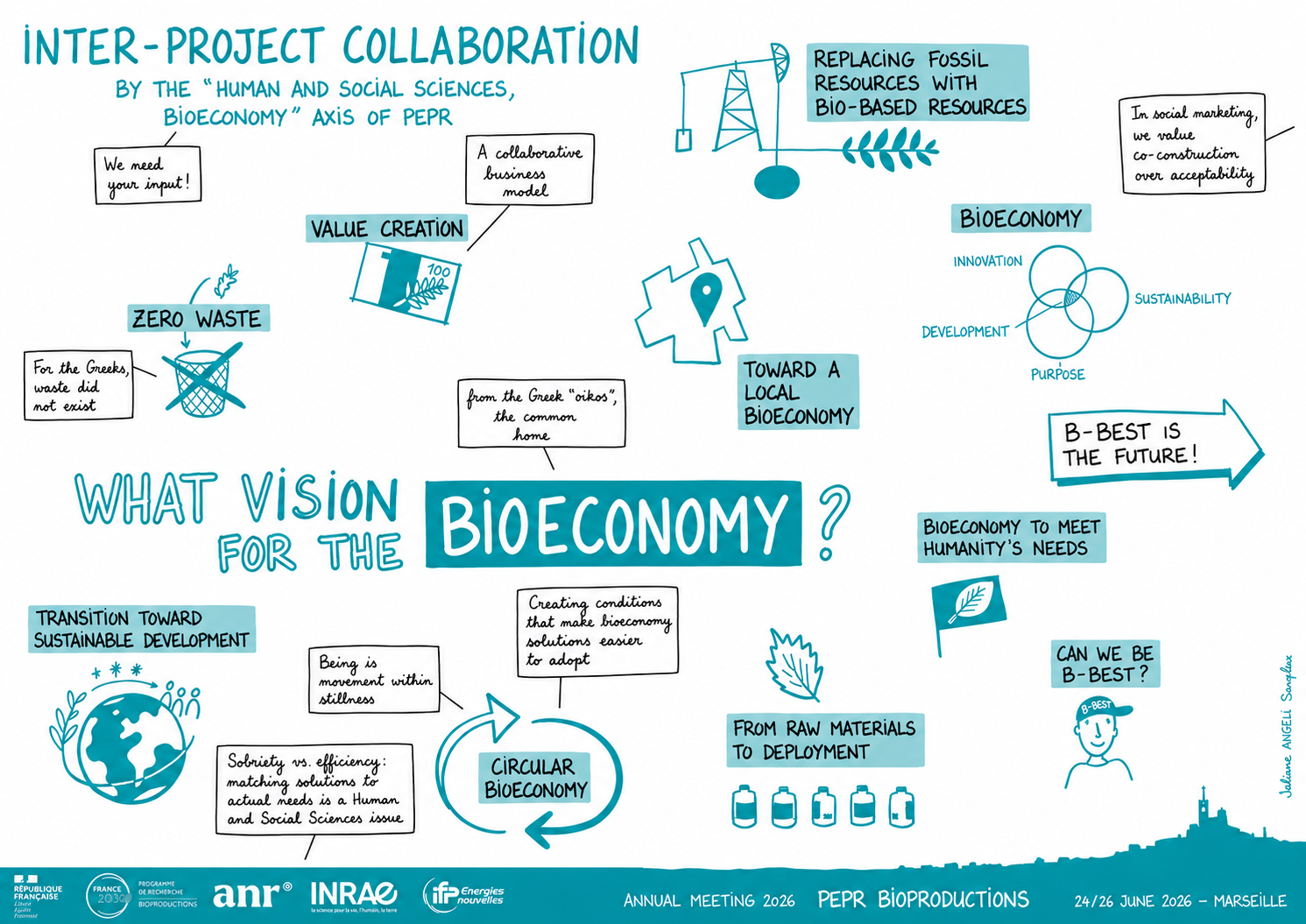
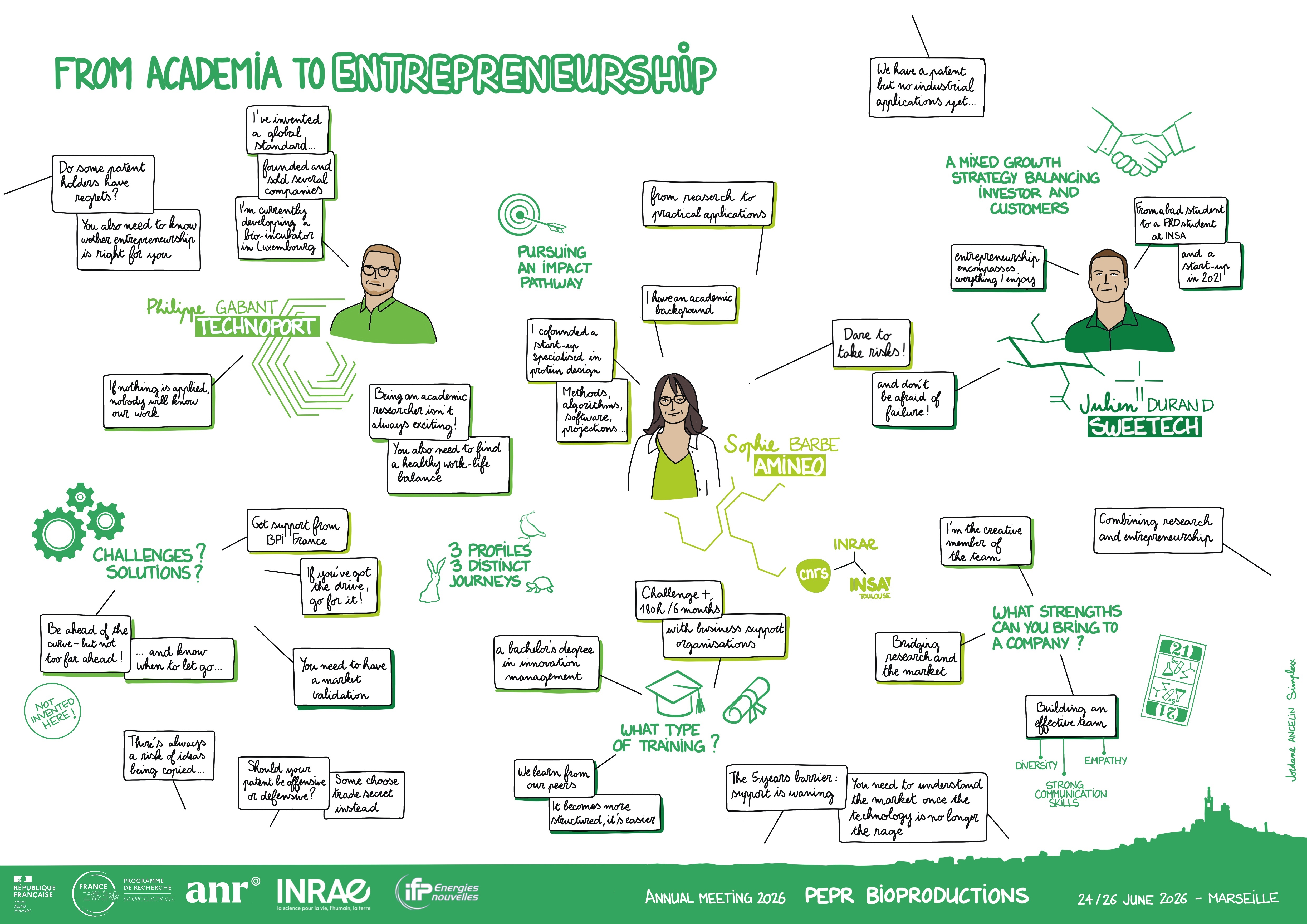
Some of the discussions were transcribed in the form of graphic summaries by illustrator Jordane Ancelin. Discover these illustrated summaries below!
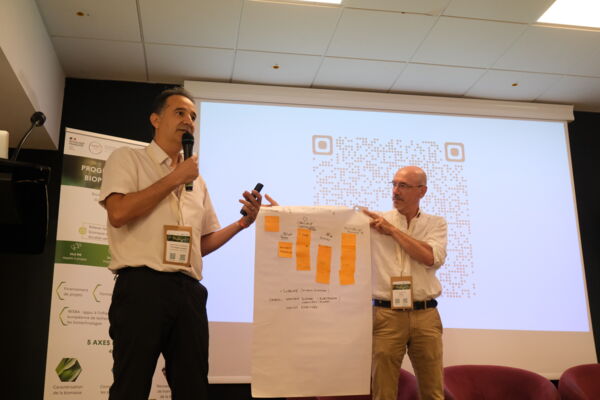
Inter-project workshop on the humanities and social sciences
An inter-project workshop organised by members of the Humanities and Social Sciences research axis (Bertrand Bocquet, Sandrine Costa, Vincent Grégoire-Delory, Cécile Raphoz, Maider Saint-Jean).
What was the aim of this workshop? To bring out and compare different visions of the bioeconomy, to examine what they entail, the questions they raise and the role played by the various stakeholders. To this end, the question posed was “What is the aim of the bioeconomy?”.
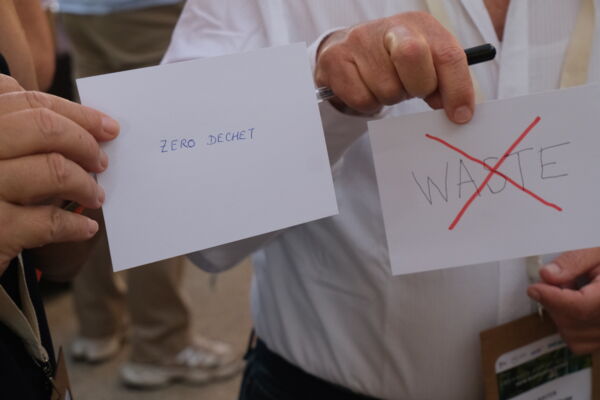
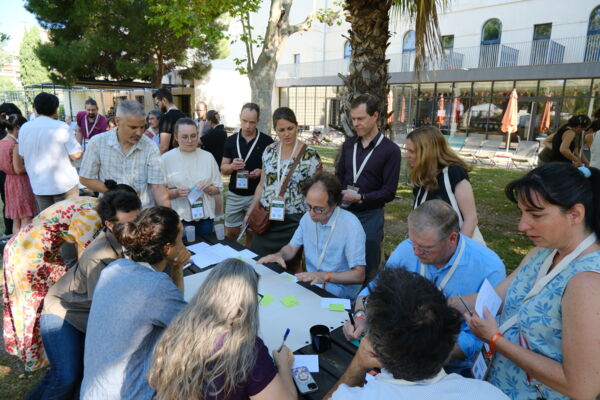
To kick off the discussions, each participant was invited to write down a single word that, in their view, represented the bioeconomy. Participants then grouped together by theme to share and explore their visions further in sub-groups.
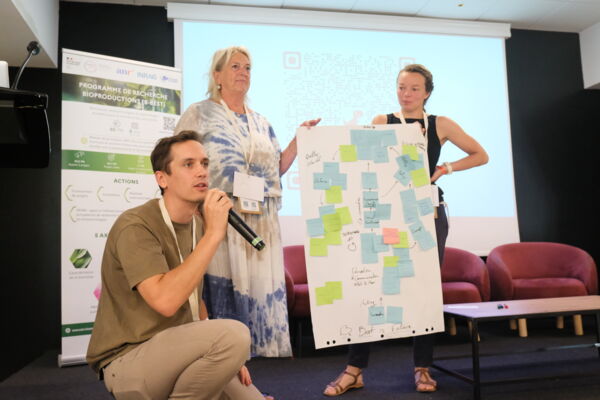
The discussions led to a cross-disciplinary review by social sciences and humanities experts, drawing on perspectives from philosophy, management sciences and sociology, and highlighting the diversity of approaches and challenges associated with the bioeconomy.
At the end of the workshop, several ways of approaching the bioeconomy emerged: the substitution of fossil resources with bioresources; the transition towards sustainable development; the journey from raw materials to deployment; zero waste; the circular bioeconomy; resource recovery; the local bioeconomy; and meeting humanity’s needs.
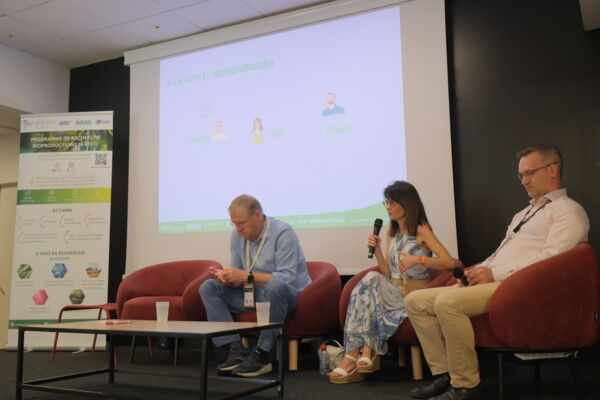
Inspiring stories on the transition from research to entrepreneurship
A round-table discussion brought together Julien Durand, Sophie Barbe and Philippe Gabant to discuss a topic that raises many questions among researchers: how do you take the leap into entrepreneurship?
- Philippe Gabant, co-founder of the synthetic biology start-up Syngulon, chose the entrepreneurial path right from the start of his career.
- Sophie Barbe, co-founder of the start-up Amineo, which specialises in AI-driven protein design, took the plunge after several years in research.
- Julien Durand, co-founder of the start-up Sweetech, which develops innovative oligosaccharides, shared an unconventional career path, marked by a variety of professional experiences before returning to his studies, completing a PhD, and then setting up his own company.
Their discussions highlighted several key lessons:
- Balancing research and entrepreneurship is possible, but it requires finding your own balance.
- There is no such thing as the ‘right’ time. Taking the plunge means accepting a degree of uncertainty and daring to take risks.
- Patents raise many questions: should you systematically protect your findings? At what stage? What value do they bring if industrial applications do not follow?
- Gaining training and building a support network is essential: training courses, support from specialist organisations and exchanges with other entrepreneurs.
- The five-year mark is an important milestone: entrepreneurs need to deepen their understanding of the market in order to continue their growth.
Thank you to the three speakers for their sincere testimonials, which show that there is no single path to entrepreneurship, but rather a diversity of journeys, experiences and choices.
Future-focused workshops to envision the innovations of tomorrow
Four future-focused workshops invited participants to explore the major challenges that will shape the bioeconomy of tomorrow.
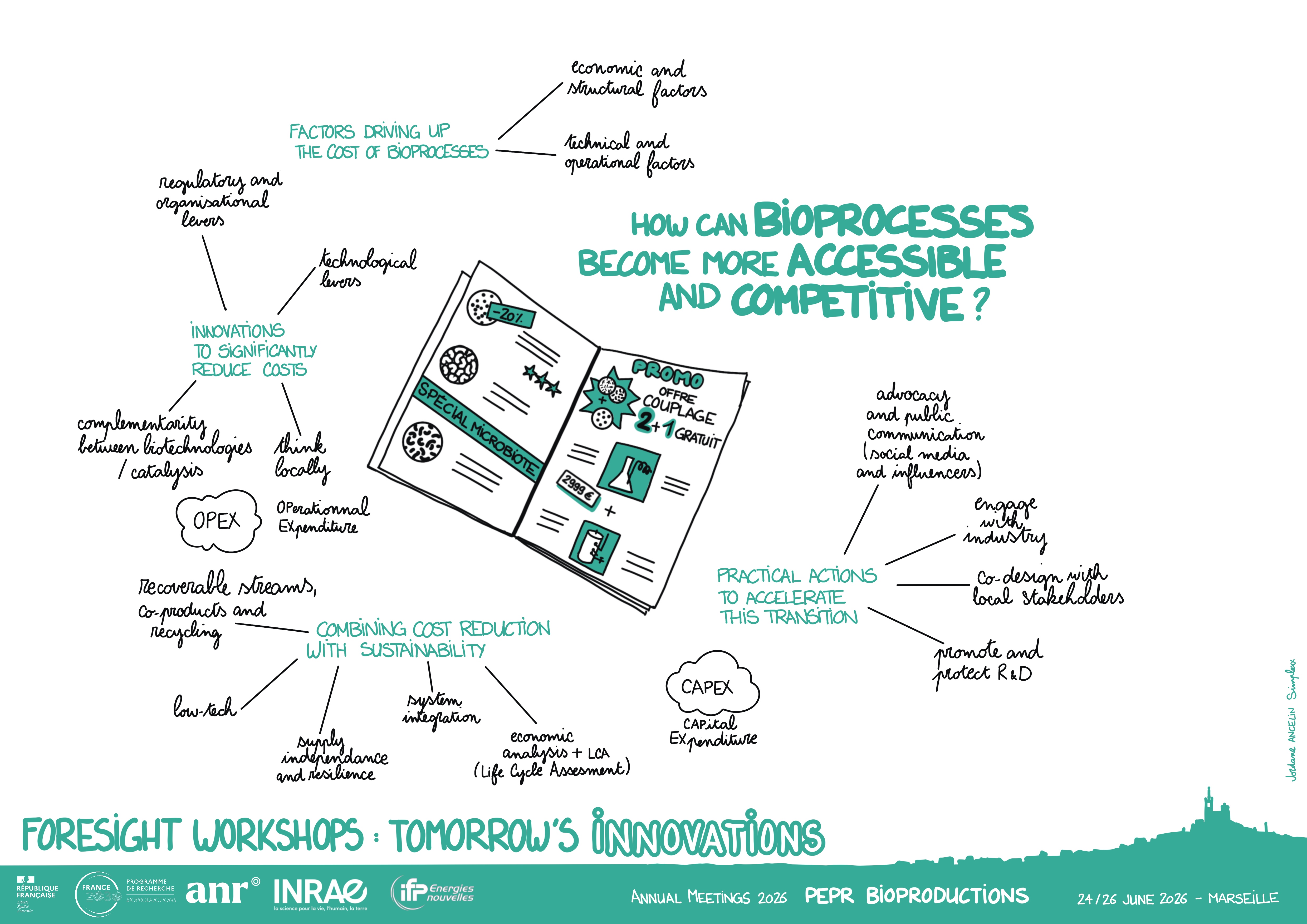
Workshop 1: How can bioprocesses be made more accessible and competitive?
The obstacles are not solely technical: they are also economic and structural. Participants identified several areas for action: changes to regulatory frameworks, the complementarity between biotechnology and chemical catalysis, as well as the utilisation of co-products, low-tech approaches, supply resilience and the incorporation of life-cycle analysis.
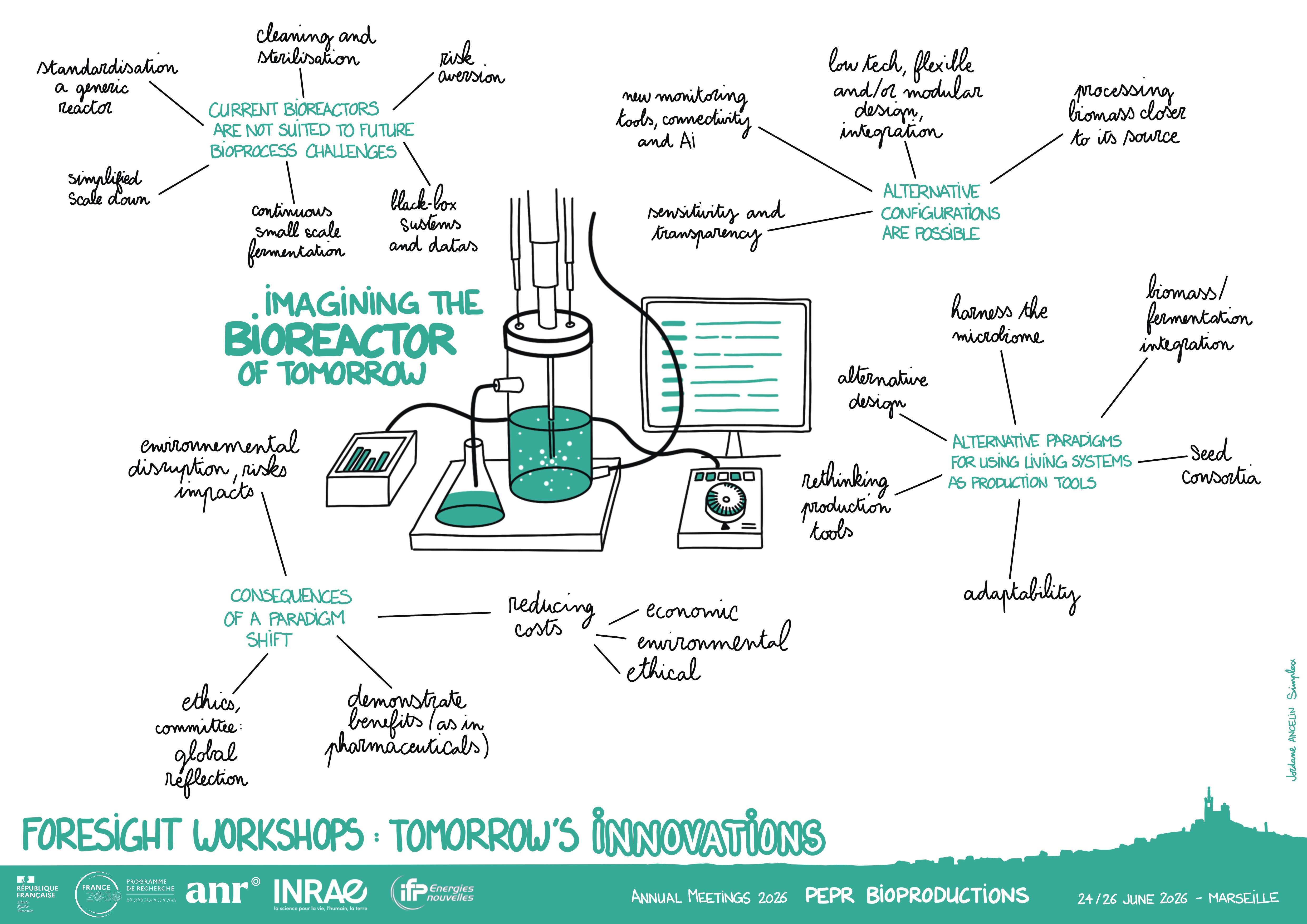
Workshop 2: What might the bioreactor of the future look like?
Current tools no longer fully meet the challenges posed by bioprocesses. The discussions highlighted several avenues for exploration: combining biomass and fermentation, new monitoring tools, flexible and modular design, and the use of the microbiome.
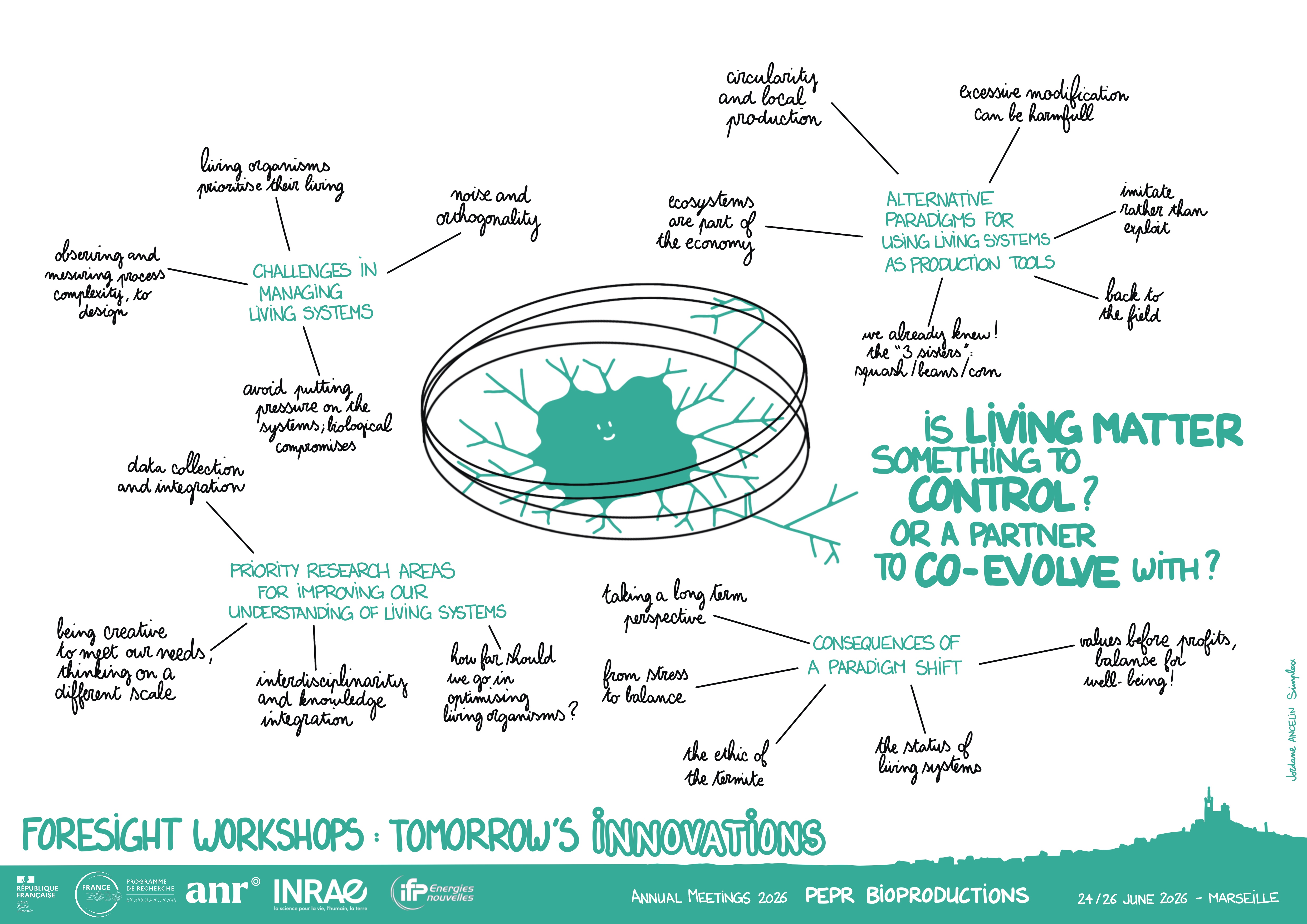
Workshop 3: Living organisms: a system to be tamed or a partner with which to co-evolve?
This workshop invited participants to rethink their perspective on living organisms. Observing and managing complex biological systems remains a challenge, particularly as living organisms prioritise their own survival above all else. The discussions paved the way for new paradigms: promoting circularity and local production, or learning to emulate the mechanisms of living organisms rather than forcing them to conform.
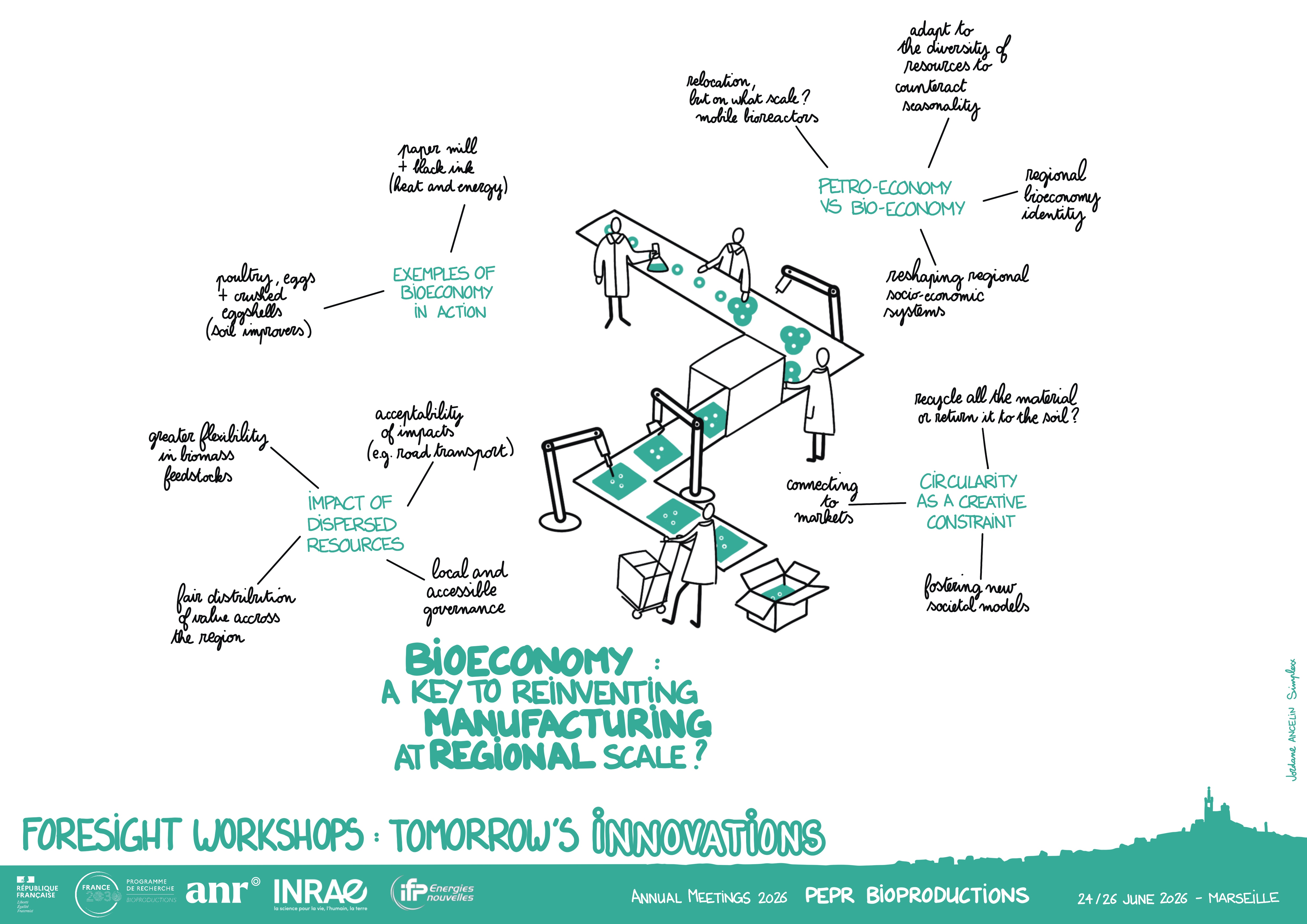
Workshop 4: Can the bioeconomy reinvent the manufacturing industry in local areas?
Participants explored the transformations involved in an industry more heavily reliant on bioresources: adapting to the diversity and seasonality of biomass, the reorganisation of the socio-economic landscape, new forms of local governance and better links to markets. Circularity emerged not only as a constraint, but also as a driver of innovation for devising new industrial and societal models.
These workshops have shown that the innovations of the future will not be purely technological. They will also require us to rethink our production models, our relationship with living organisms, and the way in which regions organise themselves around bioresources.
‘My thesis in 180 seconds’ presentations
The ‘My thesis in 180 seconds’ presentations can be found on the PEPR Bioproductions’ Canal U channel: https://www.canal-u.tv/chaines/b-best/ma-these-en-180-sec
These events are much more than just an annual gathering: they provide an opportunity to generate new ideas, strengthen collaborations and build collective momentum in support of the bioeconomy of the future.
Thank you to all the speakers and participants!