Focus on microbial electrosynthesis: when bacteria turn our waste into useful molecules
What if the next molecule for making solvents or bioplastics were hidden in wastewater? What if food waste could be turned into pigments for the textile industry? This is the aim of the teams behind the ElectroMIC research project, supported by the PEPR Bioproductions programme, which is exploring a technology capable of combining electricity and microbial activity to transform organic waste into useful molecules.
Waste: raw materials for biorefineries
In urban environmental biorefineries, organic waste represents a valuable resource: it is available in large quantities and is relatively inexpensive. Utilising it could also help reduce our dependence on fossil resources.
But transforming waste into useful molecules is not that simple. Its composition is heterogeneous and varies over time.
Today, anaerobic digestion is the main industrially mature technology for recovering value from organic waste. Other approaches are therefore being explored to take things a step further and produce higher value-added molecules from these same resources.
It all starts with electrons
Let’s go back to basics. In living organisms, redox reactions are one of the fundamental mechanisms for generating energy. They rely on the transfer of electrons from one chemical species to another. A chemical species that loses electrons is said to be ‘oxidised’, whilst one that gains electrons is said to be ‘reduced’.
Certain bacteria are of particular interest to researchers because they are capable of transferring electrons outside their cells. In particular, they can transfer them to an electrode. These bacteria are known as ‘electrogenic’.
This property lies at the heart of the microbial electrochemical technologies being studied in the ElectroMIC project.
When bacteria become tiny ‘energy converters’
The bacteria are placed in contact with an electrode, in the presence of organic waste. They grow and form a biofilm, an organised community of microorganisms on the surface of the electrode.
The bacteria then oxidise the organic matter and release electrons, which are transferred to the electrode. The bacteria thus become, in a sense, tiny biological converters capable of transferring electrons to an electrical circuit.
But the process does not stop there: these electrons are then used to produce a new molecule.
Electricity to produce a new molecule
Scientists are using microbial electrosynthesis: converting electrical energy into chemical energy using bacteria. A sort of battery, but in reverse!
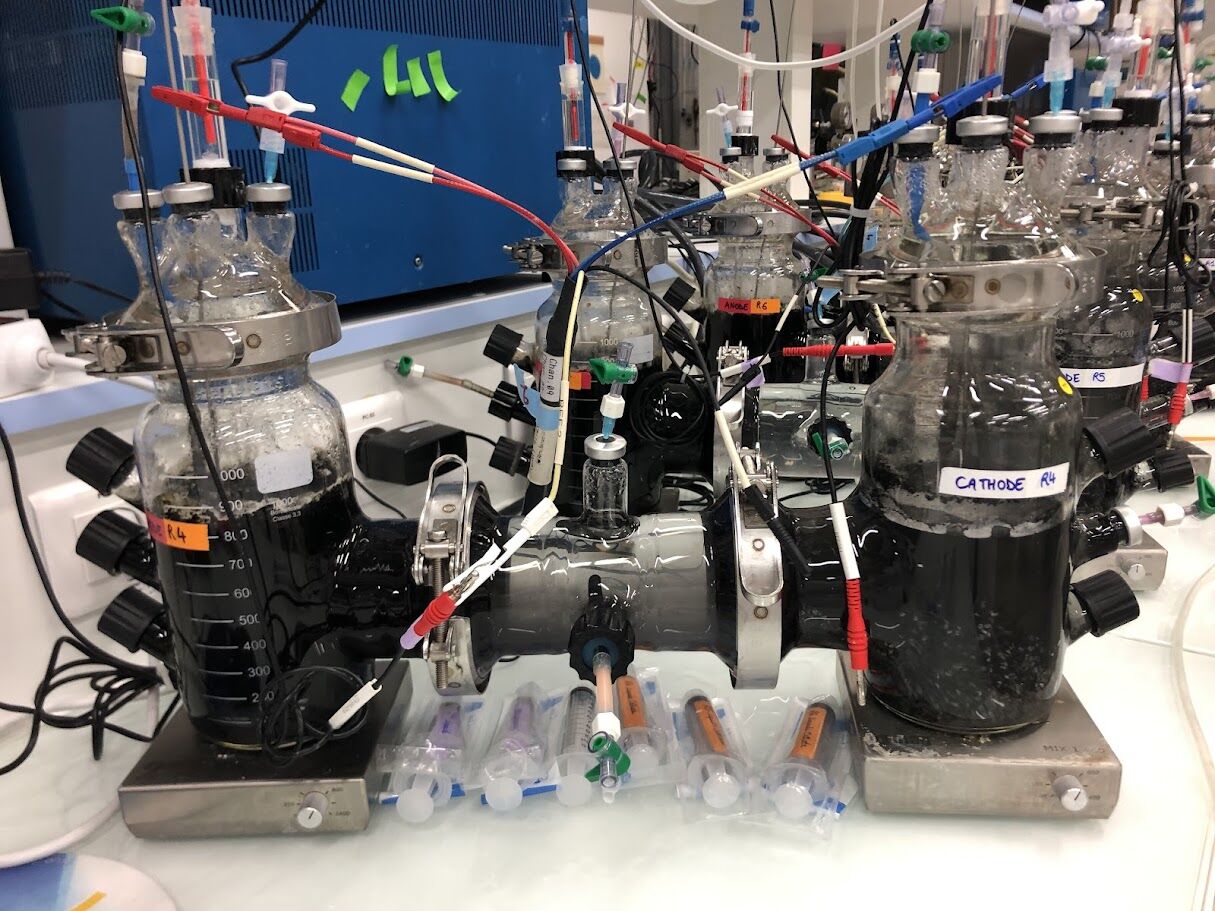
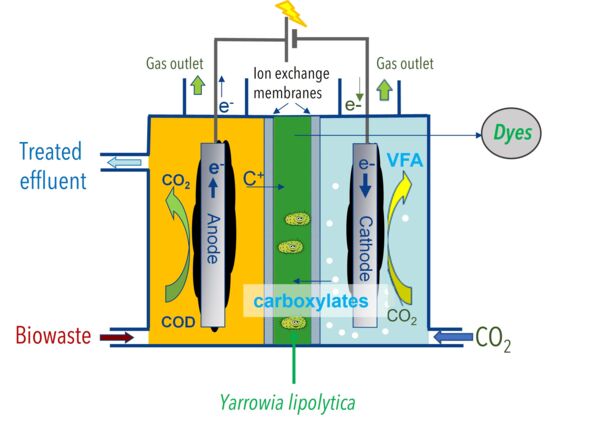
To understand the principle, let’s imagine a system consisting of two compartments (Photo 1 and Figure 1):
In the first compartment, there is organic waste and electrogenic bacteria. They consume the organic matter and release electrons.
These electrons then flow into the second compartment, where there are other bacteria capable of capturing the electrons. CO₂ is then introduced into this second compartment. The bacteria use the available electrons to transform/reduce this CO₂ and produce a molecule of interest: acetic acid.
Acetic acid is a platform molecule, meaning that it can serve as a starting point for the production of other molecules. It is particularly well known for giving vinegar its characteristic taste and smell.
Today, acetic acid is mainly produced industrially from fossil resources. With the process being studied by the ElectroMIC project, the aim is therefore to kill two birds with one stone: to recover value from waste whilst producing bio-based molecules.
Putting the right bacteria to work
The bacteria used in the various compartments come, in particular, from sludge produced during wastewater treatment. The researchers then seek to create, in each compartment, conditions favourable to the microorganisms of interest: temperature, pH, presence or absence of oxygen…
In the first compartment, conditions favour electrogenic bacteria. In the second, the aim is to favour acetogenic bacteria, capable of converting CO₂ into molecules such as acetic acid.
But these bacteria are not alone. Other microorganisms, notably methanogenic archaea, can also utilise the available electrons. They therefore compete with the acetogenic bacteria.
Why not eliminate all other species to retain only the desired bacteria?
Because it is neither simple nor necessarily desirable. Firstly, it would be difficult to completely prevent the presence of other microorganisms. Furthermore, certain species may complement or collaborate with one another and, together, contribute to the proper functioning of the microbial community.
From the laboratory to the product: when acceptability comes into play
Overcoming technological barriers is essential to fostering innovation in the development of bio-based products, but it is not sufficient on its own. Bio-based products must also meet the expectations of manufacturers and consumers.
The ElectroMIC project illustrates this issue with a concrete example. Acetic acid can then be converted into a pigment using yeast. Ultimately, these bio-based pigments could provide an alternative to synthetic dyes derived from fossil resources in the textile industry.
In connection with the PANGOLIN project, also supported by the PEPR Bioproductions programme, researchers have examined perceptions of bio-based dyes within the textile industry.
From the manufacturers’ perspective, these dyes are seen as an opportunity to stand out from the competition. Their adoption, however, depends on several conditions: they must demonstrate environmental benefits and be compatible with the sector’s technical and economic constraints.
From the consumers’ perspective, the nature of the dye appears to play a limited role in their choices. Whilst the concept of circularity may be viewed positively, the use of bio-waste as a raw material can also raise questions or cause reluctance.
This shows that the transition to a circular economy does not rely solely on the development of new technologies. It also involves reinventing value chains and the way in which products are perceived by the market.
“The circular economy is also about reinventing value chains.” Théodore Bouchez, Research Director at INRAE and head of the ElectroMIC project.
Towards more circular biorefineries
Ultimately, the aim would be to combine the microbial electrosynthesis process with the digesters in urban environmental biorefineries.
A key benefit would be the ability to utilise the CO₂ produced during anaerobic digestion, rather than treating it solely as a by-product. It could thus become a new source of carbon for producing molecules of interest using microorganisms.
The ElectroMIC project is therefore exploring a field still under development, at the crossroads of microbiology and electrochemistry, with the aim of transforming our waste into genuine resources for the bioproductions of tomorrow.
Thanks to Théodore Bouchez (Research Director, INRAE, UR PROSE) and Louise Rigaud (PhD student, INRAE, UR PROSE) for their contribution to the preparation of this article.
Louise Rigaud, Eleftheria Ntagia, Ariane Bize, Théodore Bouchez. Selection, adaptation and characterization of electrosynthetic microbial communities. Microbes Symposium by Young Researchers, Feb 2024, Saclay, France. ⟨hal-04462025⟩
Arnaud Lamy, Sandrine Costa, Christian Duquennoi. Teindre durable sans se tromper de ton. Représentations des professionnels et consommateurs sur l'adoption de colorants biosourcés dans l'industrie de la mode. 42. Congrès international de l'Association Française de Marketing (AFM) : Marketing et temporalités : rythmes, durées et horizons dans les pratiques, les marchés et les imaginaires, May 2026, Angers, France. ⟨hal-05676003⟩
By browsing our site you accept the installation and use cookies on your computer.
Know more
Our use of cookies
Cookies are a set of data stored on a user’s device when the user browses a web site. The data is in a file containing an ID number, the name of the server which deposited it and, in some cases, an expiry date. We use cookies to record information about your visit, language of preference, and other parameters on the site in order to optimise your next visit and make the site even more useful to you.
To improve your experience, we use cookies to store certain browsing information and provide secure navigation, and to collect statistics with a view to improve the site’s features. For a complete list of the cookies we use, download “Ghostery”, a free plug-in for browsers which can detect, and, in some cases, block cookies.
You can also visit the CNIL web site for instructions on how to configure your browser to manage cookie storage on your device.
In the case of third-party advertising cookies, you can also visit the following site: https://www.youronlinechoices.com/fr/controler-ses-cookies/, offered by digital advertising professionals within the European Digital Advertising Alliance (EDAA). From the site, you can deny or accept the cookies used by advertising professionals who are members.
It is also possible to block certain third-party cookies directly via publishers:
Cookie type
Means of blocking
Analytical and performance cookies
Realytics Google Analytics Spoteffects Optimizely
Targeted advertising cookies
DoubleClick Mediarithmics
The following types of cookies may be used on our websites:
Mandatory cookies
Functional cookies
Social media and advertising cookies
These cookies are needed to ensure the proper functioning of the site and cannot be disabled. They help ensure a secure connection and the basic availability of our website.
These cookies allow us to analyse site use in order to measure and optimise performance. They allow us to store your sign-in information and display the different components of our website in a more coherent way.
These cookies are used by advertising agencies such as Google and by social media sites such as LinkedIn and Facebook. Among other things, they allow pages to be shared on social media, the posting of comments, and the publication (on our site or elsewhere) of ads that reflect your centres of interest.
Our EZPublish content management system (CMS) uses CAS and PHP session cookies and the New Relic cookie for monitoring purposes (IP, response times). These cookies are deleted at the end of the browsing session (when you log off or close your browser window)
Our EZPublish content management system (CMS) uses the XiTi cookie to measure traffic. Our service provider is AT Internet. This company stores data (IPs, date and time of access, length of the visit and pages viewed) for six months
Our EZPublish content management system (CMS) does not use this type of cookie.
For more information about the cookies we use, contact INRAE’s Data Protection Officer by email at cil-dpo@inra.fr or by post at:
INRAE 24, chemin de Borde Rouge –Auzeville – CS52627 31326 Castanet Tolosan cedex - France