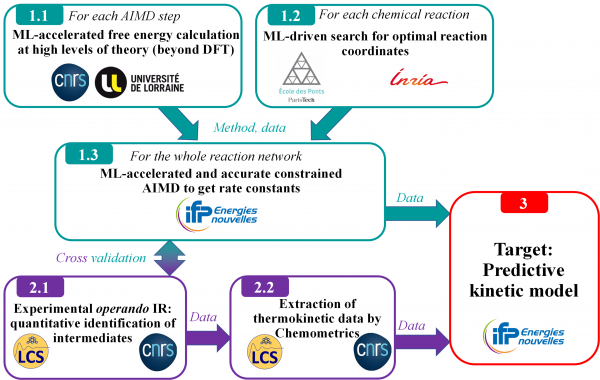
-
[hal-05785578] Trends in C2−C4 Alcohols Dehydration Catalyzed by the γ‐Alumina (100) Surface: The Isobutanol Puzzle
The monomolecular dehydration of alcohols into olefins catalyzed by the (100) surface of γ‐alumina is investigated by DFT simulations. The transition states (TS) and mean energy paths are determined for C2 to C4 alcohols through the intrinsic reaction coordinate (IRC) method. The reaction occurs through a non‐ideal E2‐type mechanism: the Cα─O bond stretching takes place before the Cβ─Hβ stretching along IRC. Quantitative structural and energetic trends are recovered: primary alcohols are the least reactive with the lower (respectively larger) Cα─O (respectively Cβ─Hβ) stretching, while secondary and tertiary are the most reactive with the larger (respectively lower) Cα─O (respectively Cβ─Hβ) stretching. However, the calculated dehydration kinetic constant of isobutanol underestimates the experimental one. By analyzing structural and charge descriptors along the IRC path and at TS, we identify that the TS of isobutanol dehydration is subject to steric hindrance between the two methyl groups present on and the (100) surface, which destabilizes the TS during the elimination. This destabilization is confirmed by the Bader charge analysis of the TS carbocationic alkyl moiety. We finally question the relevance of the Al site located on the (100) surface for catalyzing the dehydration of alcohols containing hindered mathematical equation atom.
ano.nymous@ccsd.cnrs.fr.invalid (Pierre Marmey) 08 Oct 2026
https://ifp.hal.science/hal-05785578v1
-
[hal-05673023] Open data for publication: Multivariate analysis coupled to infrared spectroscopy unravels the diversity of adsorption sites and strengths of a zeolite surface.
Raw IR spectra and scripts for their processing and MCR analysis
ano.nymous@ccsd.cnrs.fr.invalid (Reda Aboulayt) 29 Jun 2026
https://hal.science/hal-05673023v1
-
[hal-05704510] Approximating committor functions: Objective functions and enhanced sampling
Many molecular dynamics simulations aim at studying transitions between two states (from reactants to products). In this context, the committor function (which gives for a given molecular configuration the probability to reach the product state before the reactant state) is a pivotal quantity, in particular because it is the optimal importance function for rare event simulation methods such as importance sampling or splitting techniques. These methods are used to sample the reactive path ensemble, and estimate for example the transition rate. However, learning such a function is generally a challenging task due to the high dimensionality of the configuration space. In this work, after reviewing the existing methodologies to construct approximate committor functions, a new loss function based on the application of Itō's formula is proposed to learn the committor function with a minimization procedure on the parameters of a neural network. After comparing this novel approach to existing procedures on the Müller-Brown potential, we introduce a coupling strategy with the Adaptive Multilevel Splitting method to better approximate the committor function using a better sampling of the reactive trajectories. This methodology in which the committor function is iteratively learned only requires initially the knowledge of the reactant and product states.
ano.nymous@ccsd.cnrs.fr.invalid (Thomas Pigeon) 27 Jul 2026
https://hal.science/hal-05704510v1
-
[hal-05581048] Multivariate analysis coupled to infrared spectroscopy unravels the diversity of adsorption sites and strengths of a zeolite surface
Quantifying adsorption thermodynamics on heterogeneous catalysts remains challenging because macroscopic techniques yield averaged parameters, while vibrational spectra often contain strongly overlapping contributions from multiple adsorbed species. Here we introduce an infrared (IR)-chemometric framework that extracts site-specific adsorption thermodynamics directly from experimental IR isotherms and we benchmark it against independent microcalorimetry and density functional theory (DFT) calculations. Difference IR spectra recorded for isobutanol adsorption on H-ZSM-5 (MFI) were analysed by principal component analysis and multivariate curve resolution (MCR-ALS) under soft constraints (monotonic concentration profiles, spectral normalisation), and further refined using a hard–soft strategy in which concentration profiles are constrained by an adsorption model. The analysis reveals three adsorption modes associated with bridging Brønsted OH groups, extra-framework Al–OH species, and silanols, providing representative pure-component spectra and site-resolved adsorption isotherms. The thermodynamic trends and site hierarchy obtained from IR–MCR-ALS are consistent with independent microcalorimetry measurements and density functional theory calculations, validating the approach. More broadly, IR–MCR-ALS offers a transferable route to quantitative, site-resolved adsorption thermodynamics in complex catalysts.
ano.nymous@ccsd.cnrs.fr.invalid (Reda Aboulayt) 05 Apr 2026
https://hal.science/hal-05581048v1
-
[hal-05674613] Isobutanol Dehydration to Linear Butenes on Ferrierite: Mechanistic Insights from operando FTIR, Chemometrics and Kinetic Modelling
The selective dehydration of isobutanol to linear butenes catalyzed by acidic ferrierite (H-FER) has been investigated by operando IR spectroscopy under close batch conditions and along a temperature ramp. The employed apparatus permits to alternatively acquire spectra of both the gas phase composition and the species adsorbed on the H-FER surface, thus providing fundamental insights onto the products formation and the reaction intermediates formed on the catalyst surface. In the gas phase, the high selectivity for linear butenes was confirmed in the first phases of the reaction, followed by a slower isomerization to isobutene and by the formation of heavier compounds due to secondary processes. Detailed MCR-ALS analysis of the adsorbed species’ spectra permitted to also identify and quantify adsorbed 2-butanol and trans-2-butene on the H-FER surface, providing a first indication of the alcohol isomerization as a key step in the reaction mechanism. The proposed mechanism was evaluated by microkinetic modelling of both gas phase and surface concentration profiles, showing that the consecutive isomerization of isobutanol to adsorbed 2-butanol followed by its dehydration to trans-2-butene is more favorable than the one-step dehydration-isomerization of isobutanol. In contrast, the direct dehydration of isobutanol to isobutene was found to be slower over the entire investigated temperature range.
ano.nymous@ccsd.cnrs.fr.invalid (Eleonora Vottero) 30 Jun 2026
https://hal.science/hal-05674613v1
-
[hal-05673913] Isobutanol dehydration catalyzed by bridging OH groups at the (100) surface of ferrierite: From static DFT to machine learning accelerated molecular dynamics
Ferrierite is industrially used as a catalyst for the dehydration of isobutanol into butenes and the critical part of this transformation is presumably catalyzed by Brønsted acid (BA) sites located on its external surface. In this work, we present a DFT investigation of a complete reaction network over the T1O3 BA site at the (100) surface of this zeolite. Exploration of reaction mechanisms by means of the static approach revealed that the transformation towards all products proceeds in two steps - dehydration and deprotonation - with the former step being rate determining for all competing reaction channels. Free energetics of the dehydration reaction was therefore investigated using ab initio molecular dynamics accelerated by machine-learned force fields with accuracy controlled via a correction scheme based on machine learning perturbation theory. The activation free energies for transformations towards branched and linear products computed using the PBE+D2 functional (111.3 and 125.7 kJ/mol, respectively) suggest a preference of the former reaction channel. This conclusion was found to be independent of the dispersion correction used with the PBE functional (no correction, D3, D3(BJ), and D4) and of the choice of bridging OH group, as shown for the alternative T3O1 and T4O7 sites. Interestingly, our results are in agreement with our previous investigation of analogous reactions catalyzed by bulk chabazite. At the same time, however, they do not reproduce the experimental selectivities observed for ferrierite, which suggests that the bridging OH groups are not at the origin of the specific selectivity of ferrierite for linear alkenes.
ano.nymous@ccsd.cnrs.fr.invalid (Katarína Skladanová) 30 Jun 2026
https://ifp.hal.science/hal-05673913v1
-
[hal-05082773] Isobutanol dehydration catalyzed by HFER: mechanism insights from FT-IR and kinetic modelling
[...]
ano.nymous@ccsd.cnrs.fr.invalid (Eleonora Vottero) 27 May 2025
https://hal.science/hal-05082773v1
-
[hal-05116066] Selective Isobutanol Dehydration Catalyzed by H-FER: Mechanism Investigation By Operando IR, Chemometrics and Microkinetics
HFER is a promising catalyst for the direct dehydration and isomerization of bio-sourced isobutanol to linear butenes. By combining operando IR, chemometrics and microkinetic modelling, we managed to shed new light to the unusual reaction mechanism.
ano.nymous@ccsd.cnrs.fr.invalid (Eleonora Vottero) 17 Jun 2025
https://hal.science/hal-05116066v1
-
[hal-05673026] Open data for publication : Isobutanol Dehydration to Linear Butenes on Ferrierite: Mechanistic Insights from operando FTIR, Chemometrics and Kinetic Modelling
Dataset associated with the analysis described in the paper "Isobutanol Dehydration to Linear Butenes on Ferrierite: Mechanistic Insights from operando FTIR, Chemometrics and Kinetic Modelling". The folder includes: raw spectra of the operando FTIR experiment under batch conditions reference spectra measured in situ the python script containing the MCR-ALS analysis of the spectra associated with the species adsorbed on H-FER the measured concentration profiles of all quantified species the python script containing the kinetic model fit calculations
ano.nymous@ccsd.cnrs.fr.invalid (Eleonora Vottero) 29 Jun 2026
https://hal.science/hal-05673026v1
-
[hal-05104701] Phase Sensitive Detection analysis of Modulation Excitation Spectra... such a thing as a free lunch ?
Phase Sensitive Detection is examined in the framework of multivariate curve resolution (MCR) models. It is shown that PSD should be used with caution, as noise reduction is also accompanied by a loss of information on active species. Alternative processing and analysis of modulation excitation spectra are proposed.
ano.nymous@ccsd.cnrs.fr.invalid (Eleonora Vottero) 10 Jun 2025
https://hal.science/hal-05104701v1
-
[hal-05622338] Modulation Excitation Spectroscopy beyond Phase-Sensitive Detection
[...]
ano.nymous@ccsd.cnrs.fr.invalid (Eleonora Vottero) 13 May 2026
https://hal.science/hal-05622338v1
-
[hal-05622341] Selective dehydration of isobutanol on H-FER: operando IR, multivariate analysis and kinetic modeling
Introduction Acidic ferrierite (H-FER) is able to dehydrate isobutanol to linear butenes with high selectivity, but the reaction mechanism explaining such selectivity remains elusive.1 This work aims to elucidate the reaction mechanism and provide kinetic rate constants for the main reaction. Results & Discussion The measurements were performed in a custom-made IR cell operating as a closed batch operando reactor and allowing to measure simultaneously the gas phase composition and the species adsorbed on the catalyst. Isobutanol dehydration on HFER was followed along temperature ramps from 40 to 260°C. Intermediates and products were identified and quantified by MCR-ALS analysis of the surface spectra (Figure 1B) and by fitting gas spectra with known references. The high selectivity to linear butenes was confirmed, and 2-butanol was found as an intermediate adsorbed at the HFER surface, suggesting that the key reaction step is the isomerization of the alcohol to the linear isomer. The validity of the proposed mechanism was confirmed by microkinetic modelling of both surface and gas phase concentration profiles, which also showed that the rate limiting step is the alcohol isomerization step. This is the first experimental confirmation of previous computational predictions on a comparable system. Significance This work demonstrates the potential of closed-batch operando IR for identifying reaction intermediates and enabling kinetic modeling of both gas-phase and surface concentrations in catalytic reactions. Applied to the selective dehydration of isobutanol on HFER, it provides the first experimental evidence that the key reaction step is the isomerization of isobutanol to 2-butanol.
ano.nymous@ccsd.cnrs.fr.invalid (Eleonora Vottero) 13 May 2026
https://hal.science/hal-05622341v1
-
[hal-05477215] Linear versus branched products: how dynamical effects influence the transformations of isobutanol catalyzed by acidic zeolites
Ab initio molecular dynamics (AIMD) calculations were performed to study isomerization (I1), synchronous dehydration and isomerization (DHI1) and dehydration (DH1) reactions of isobutanol over acid chabazite leading to formation of branched products, i.e., tert-butanol, tert-butyl cation, and isobutene, respectively. Reactions I1 and DHI1 were shown to be variants of the same transformation, differing only in the relative position of water with respect to the carbenium cation formed after passing through a common transition state. The Bennett–Chandler approach predicted that DHI1 is strongly favored over variant I1, mainly due to stability of the tert-butyl intermediate interacting with water, which is further enhanced by the entropic effect. The relative importance of this class of transformations compared to the I2 and DHI2 reactions leading to the formation of linear products (n-butanol, n-butyl cation, n-butenes) was assessed. At the experimentally relevant temperature of 500 K, reactions ultimately yielding isobutene (DHI1 and I1) were found to be dominant, in line with experimental observations made for large pore zeolites. Although the transformations leading to linear butenes (DHI2, I2) are slower, with rate constants 1–2 orders of magnitude lower than those of DHI1/I1, they are still competitive. The importance of dynamic effects was underlined by comparison with a static approach, which strongly underrated importance of synchronous dehydration and isomerization reaction channels.
ano.nymous@ccsd.cnrs.fr.invalid (Monika Gešvandtnerová) 26 Jan 2026
https://ifp.hal.science/hal-05477215v1
-
[hal-04878044] Machine learning thermodynamic perturbation theory offers accurate activation free energies at the RPA level for alkene isomerization in zeolites
The determination of accurate free energy barriers for reactions catalyzed by proton-exchanged zeolites by quantum chemistry approaches is a challenge. While ab initio molecular dynamics is often required to sample correctly the various states described by the system, the level of theory also has a crucial impact. In the present work, we report the determination of accurate barriers for a type B isomerization of a monobranched C7 alkene (4-methyl-hex-1-ene) into a dibranched tertiary cation inside a protonated chabazite zeolite. This is done by using the Machine Learning Thermodynamic Perturbation Theory (MLPT) at the Random Phase Approximation (RPA) level, on the basis of blue-moon sampling dynamic data obtained at the Generalized Gradient Approximation (GGA) level (PBE+D2). The comparison of PBE+D2 and RPA profiles shows that the former overstabilizes cationic intermediates with respect to neutral ones. The transition state of the isomerization is a non-classical edge protonated cyclopropane, the stabilization of which is lower than that of the π-complex when PBE+D2 is replaced by RPA, but higher than that of the classical tertiary carbenium. Consequently, the backward isomerization barrier is decreased. Applying the MLPT approach to recompute the free energy barriers with various dispersion correction schemes to the PBE energies shows that none of the schemes is sufficient to improve both the forward and backward barriers with respect to the RPA reference. These data complement previously determined alkene cracking barriers [Rey et al., Angew. Chem., Int. Ed., 2024, 63, e202312392], thanks to which it is possible to compare the presently determined barriers with reference experimental data [Schweitzer et al., ACS Catal., 2022, 12, 1068–1081]. The agreement with experiments is significantly improved at the RPA with respect to GGA. Chemical accuracy is approached (maximum deviation of 6.4 kJ mol−1), opening the door to predictive kinetic modelling starting from first principles approaches.
ano.nymous@ccsd.cnrs.fr.invalid (Jérôme Rey) 09 Jan 2025
https://ifp.hal.science/hal-04878044v1
-
[hal-04504311] Reference‐Quality Free Energy Barriers in Catalysis from Machine Learning Thermodynamic Perturbation Theory
For the first time, we report calculations of the free energies of activation of cracking and isomerization reactions of alkenes that combine several different electronic structure methods with molecular dynamics simulations. We demonstrate that the use of a high level of theory (here Random Phase Approximation—RPA) is necessary to bridge the gap between experimental and computed values. These transformations, catalyzed by zeolites and proceeding via cationic intermediates and transition states, are building blocks of many chemical transformations for valorization of long chain paraffins originating, e.g., from plastic waste, vegetable oils, Fischer–Tropsch waxes or crude oils. Compared with the free energy barriers computed at the PBE+D2 production level of theory via constrained ab initio molecular dynamics, the barriers computed at the RPA level by the application of Machine Learning thermodynamic Perturbation Theory (MLPT) show a significant decrease for isomerization reaction and an increase of a similar magnitude for cracking, yielding an unprecedented agreement with the results obtained by experiments and kinetic modeling.
ano.nymous@ccsd.cnrs.fr.invalid (Jérôme Rey) 14 Mar 2024
https://ifp.hal.science/hal-04504311v1
-
[hal-04592530] Importance of Dynamic Effects in Isobutanol to Linear Butenes Conversion Catalyzed by Acid Zeolites Assessed by AIMD
Dehydration of alcohols into alkenes is a key reaction for the production of fuels and chemicals from biomass. However, the mechanism of these reactions is highly questionable, hindering the rational optimization of efficient catalysts. In the present work, the formation of linear butenes starting from isobutanol catalyzed by proton-exchanged zeolites is unraveled by ab initio molecular dynamics (AIMD). Comparison with static calculations done for a gas phase reaction catalyzed by a proton and for the prototypical chabazite zeolite framework shows that AIMD estimations of the free energy barriers are significantly different from the static ones. Moreover, a common transition state (TS) is found for two competing reactions, namely, the isomerization of isobutanol into butan-2-ol (the dehydration of the latter yielding linear butenes) and the synchronous dehydration and isomerization of isobutanol into products related to linear butenes in a single step. The existence of a post-TS bifurcation prevents a traditional estimation of rates by transition state theory. To circumvent this problem, we quantify relative transmission coefficients using the Bennett–Chandler theory, which shows a clear tendency for decrease of relative frequency for isobutanol isomerization and increase of that for synchronous dehydration and isomerization when switching from 100 to 500 K. This work represents a step forward for the accurate determination of rates for key reactions in alcohol dehydration reactions.
ano.nymous@ccsd.cnrs.fr.invalid (Monika Gešvandtnerová) 29 May 2024
https://ifp.hal.science/hal-04592530v1
-
[hal-05585455] Unbiased molecular dynamics for the direct determination of catalytic reaction times: Paving the way beyond transition state theory
[...]
ano.nymous@ccsd.cnrs.fr.invalid (Thomas Pigeon) 09 Apr 2026
https://ifp.hal.science/hal-05585455v1
-
[hal-05412282] Calculating free-energy differences using an average force: A tutorial for adaptive biasing force simulations
The purpose of this tutorial is to get the reader familiarized with the calculation of a free-energy change along a reaction-coordinate (RC) model through a number of applications of variants of the importance-sampling adaptive biasing force algorithm. The reversible sodium-chloride ion pairing in aqueous solution serves as an introductory example, wherein the RC model is defined as the distance separating the ions. For the reversible folding of the short peptide deca-alanine, alternative collective variables are considered to map the conformational free-energy landscape. The importance-sampling algorithm is then applied to the transfer of an ethanol molecule across the water liquid-vapor interface to estimate its hydration free-energy. The results are compared to those of an alchemical transformation, using free-energy perturbation calculations. In the final application, the Ramachandran free-energy surface underlying the conformational equilibrium of N-methyl-N'-acetylalanylamide is determined in two dimensions, comparing single-and multiple-walker strategies.
ano.nymous@ccsd.cnrs.fr.invalid (Radu Talmazan) 11 Dec 2025
https://hal.science/hal-05412282v1
-
[hal-05469683] Following the Committor Flow: A Data-Driven Discovery of Transition Pathways
The discovery of transition pathways to unravel distinct reaction mechanisms and, in general, rare events that occur in molecular systems is still a challenge. Recent advances have focused on analyzing the transition path ensemble using the committor probability, widely regarded as the most informative one-dimensional reaction coordinate. Consistency between transition pathways and the committor function is essential for accurate mechanistic insight. In this work, we propose an iterative framework to infer the committor and, subsequently, to identify the most relevant transition pathways. Starting from an initial guess for the transition path, we generate biased sampling from which we train a neural network to approximate the committor probability. From this learned committor, we extract dominant transition channels as discretized strings lying on isocommittor surfaces. These pathways are then used to enhance sampling and iteratively refine both the committor and the transition paths until convergence. The resulting committor enables accurate estimation of the reaction rate constant. We demonstrate the effectiveness of our approach on benchmark systems, including a two-dimensional model potential, peptide conformational transitions, and a Diels--Alder reaction.
ano.nymous@ccsd.cnrs.fr.invalid (Cheng Giuseppe Chen) 21 Jan 2026
https://hal.science/hal-05469683v1
-
[hal-05469657] From Atoms to Dynamics: Learning the Committor Without Collective Variables
<div><p>We introduce a graph-neural-network architecture built on geometric vector perceptrons to predict the committor function directly from atomic coordinates, bypassing the need for hand-crafted collective variables (CVs). The method offers atom-level interpretability, pinpointing the key atomic players in complex transitions without relying on prior assumptions. Applied across diverse molecular systems, the method accurately infers the committor function and highlights the importance of each heavy atom in the transition mechanism. It also yields precise estimates of the rate constants for the underlying processes. The proposed approach assists in understanding and modeling complex dynamics, by enabling CV-free learning and automated identification of physically meaningful reaction coordinates of complex molecular processes.</p></div>
ano.nymous@ccsd.cnrs.fr.invalid (Sergio Contreras Arredondo) 21 Jan 2026
https://hal.science/hal-05469657v1
-
[hal-05469667] From Static Pathways to Dynamic Mechanisms: A Committor-Based Data-Driven Approach to Chemical Reactions
[...]
ano.nymous@ccsd.cnrs.fr.invalid (Radu Talmazan) 21 Jan 2026
https://hal.science/hal-05469667v1
-
[hal-05076578] Multivariate analysis of IR spectroscopic isotherms: a new method for the characterization of adsorption at the molecular scale
In this communication we show how in situ IR spectroscopy combined with multivariate analysis can be used to identify and characterize quantitatively the adsorption, in particular alcohol on zeolites.
ano.nymous@ccsd.cnrs.fr.invalid (Reda Aboulayt) 21 May 2025
https://hal.science/hal-05076578v1